
Sanitizing Suicide
Biopolitics & Bodies
[op-ed]
Sanitizing Suicide
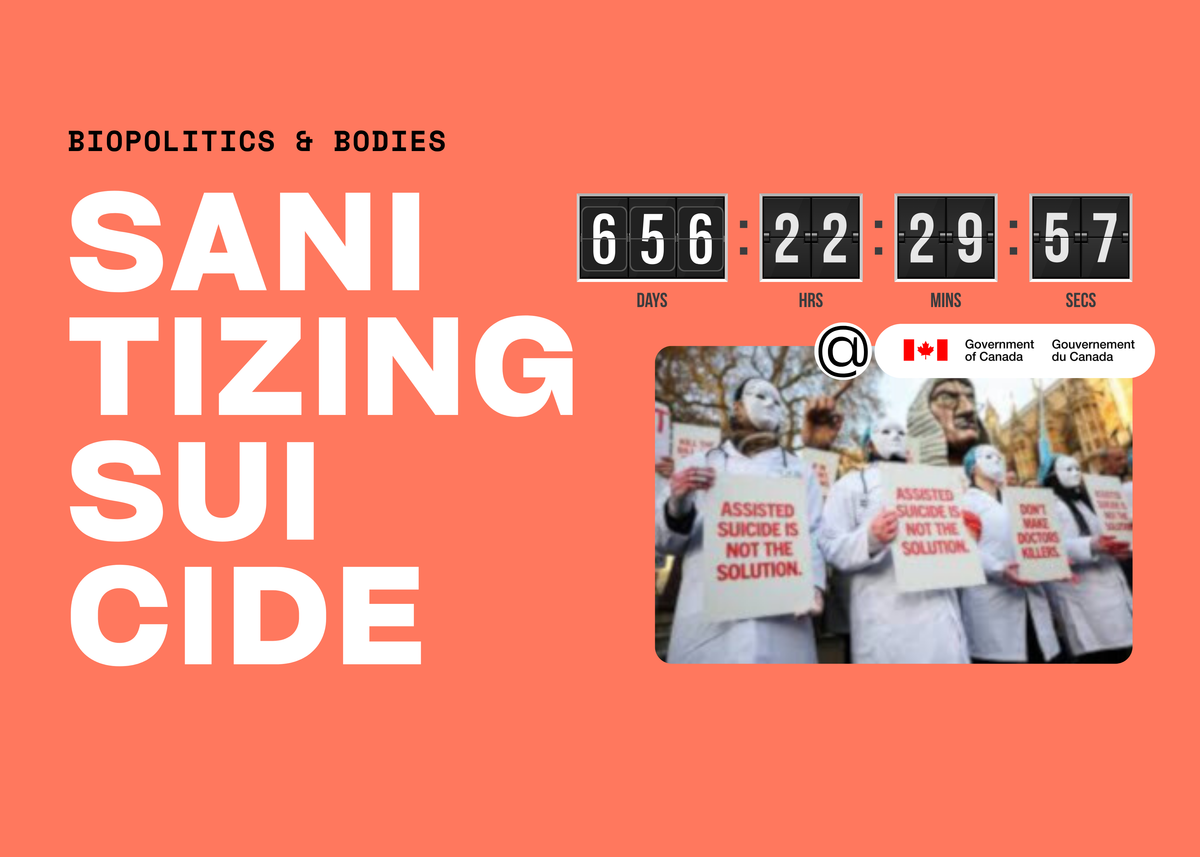
Coming soon to Canadian medical facilities… the medicalization of suffering. Proceeding the current three-year pause in eligibility extensions due to concerns uncovered during consultation with provinces and medical professionals, March 2027 will see the contested medical assistance in dying (MAID) program to be extended to include mental health conditions. While already stirring conversation surrounding ethics due to the vague and superficial eligibility requirements MAID is slated to expand to include individuals that have “intolerable physical or psychological suffering” in which they feel there are no other curative options available (CANGOV). What was introduced as a dignified way to die for terminal patients is now being ushered in as an effective and viable medical treatment for patients with no foreseeable death. This approach lacks nuance as to how mental health is affected by social factors and its timing renders the move tone-deaf.
Currently, MAID is being questioned on its stake within medical treatment plans. Rather than aligning with other international policies, Canada does away with safeguards. For example, the ‘last resort’ policy in the Netherlands only grants eligibility to individuals after all other curative measures are exhausted (Kim, 2023). In Canada this is not needed, individuals can refuse other treatment if they think it is unfit – skipping right to MAID applications. This attitude and policy point to the public labelling of this procedure as something it is not – a treatment option, that is medically effective when it really is a terminal ‘solution’. This wording also allows Canadian providers to suggest and even promote MAID as a treatment option, compared to the same conversations being prohibited in Australia and New Zealand – where it is up to patients to bring up concerns and interests (Lemmens & Krakowitz-Broker, 2020). A Canadian MAID provider goes on to share that in some cases it is a lack of care and hope that turned patients to apply for MAID (Li & Agrba, 2023).
It is important to highlight the current state of curative options and treatments in Canada. In the last number of years wait times, privatized costs and overall access have become more inadequate. Mandatory wait times for chronic illness and soon, mental health sufferers to receive MAID is 90 days, however, chronic illness specialists average a 126-day waiting list (Lemmens & Krakowitz-Broker, 2020). I myself waited 4 years to get a call to schedule an appointment with a pediatric psychiatrist, by then I had already aged out. My point is that curative treatment options are so inadequate and out of reach for most people and MAID seems like an easy way out for the failing medical system - gaslighting vulnerable people on the promise of bodily autonomy.
With headlines circling that the Canadian medical system is failing and shortages are commonplace the idea of extending MAID policy to those with mental health disorders feels cowardly – unable to acknowledge their failings the medical system and governing bodies are offering a terminal solution instead of seeking a foundational resolution. I think it is a fair argument to assume that Canadians would not want to end their lives if opportunities to restore their health, mental or physical, are available. What underpins this issue is the lack of written policy that includes clinical judgment. Clinicians and MAID advisors are under no obligation to understand patients suffering and offer available supports - if you check the boxes, you are eligible (Li & Agrba, 2023).
This is not a moral conversation over bodily autonomy - I believe MAID provides dignified dying for those with terminal illnesses who do not want to suffer in their last days – however, otherwise healthy people are being failed by the medical system. Effectively sanitizing suicide and desensitizing death in the name of healthcare. This is not a treatment option; this is a last-ditch effort to create a facade that there are options for mental health issues by a system that is unequipped. Bodily autonomy and agency are virtuous, however, individuals, specifically vulnerable and ill individuals are being sold a lie. A lie that they have no other options, and that death is the only option left. I argue this enables hopelessness.
Instead of accepting MAID as a viable treatment, we should seek to mend the social strains that have exacerbated mental health issues in the last number of decades. Establishing housing support and managing the cost-of-living issue, enabling alternative and new curative treatments, funding research, and Moreso incentivizing individuals to feel empowered in taking care of their health would be better fit solutions. A dependency on the healthcare system has both deteriorated it and created generations of people who are either scared or unwilling to take charge of their health. This isn’t to say individuals cannot rely on healthcare, but an understanding that we have agency over our bodies outside of the hospital or doctor’s office would be a good start.
ReferencesGovernment of Canada, Criminal Justice. (2023). Canada’s medical assistance in dying (MAID) law. https://www.justice.gc.ca/eng/cj-jp/ad-am/bk-di.htmlKim, S. (2023, February). In Canada, MAID has become a matter of ideology. The Globe and Mail, Opinion. https://www.theglobeandmail.com/opinion/article-in-canada-maid-has- become-a-matter-of-ideology/Lemmens, T., & Krakowitz-Broker, L. (2020, November). Why the federal governments should rethink its new medical assistance in dying law. CBC, Opinion.https://www.cbc.ca/news/opinion/opinion-medical-assistance-in-dying-maid-legislation- 1.5790710Li, M., & Agrba, L. (2023, February). I am a MAID provider. It’s the most meaningful - and maddening - work I do. Here’s why. Macleans, Society. https://macleans.ca/society/i-am- a-maid-provider-its-the-most-meaningful-and-maddening-work-i-do-heres-why/