Colonial Curation.
Global Grievances
[Media Release]
Seismic Shifts at the Museum of Anthropology.
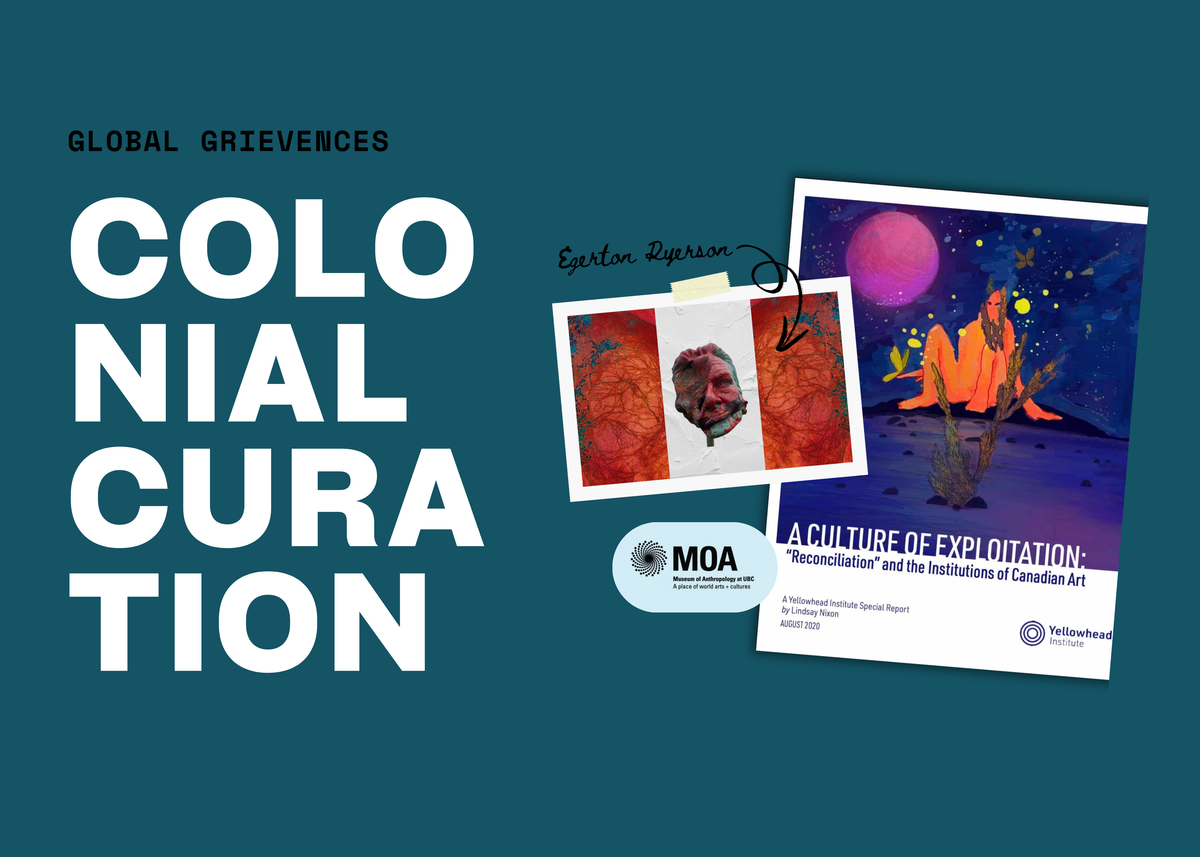
Five years ago, I was studying at Toronto Metropolitan University, then Ryerson. An ironic yet fruitful juxtaposition, I was studying at a university that sat on precariously obtained Indigenous land, watching their namesake’s statue be decapitated in real-time. All while attending a compulsory course about Indigenous ways of knowing. Was this a performative attempt at checking reconciliation off of an executive to-do list? Maybe.
But, while cynicism is often the easy way out, without this blatant incongruency between institutions and scholars, I would have missed out on the privilege of being in Dr. Eva Jewel’s class, which exposed me to the then-emerging Yellowhead Institute.
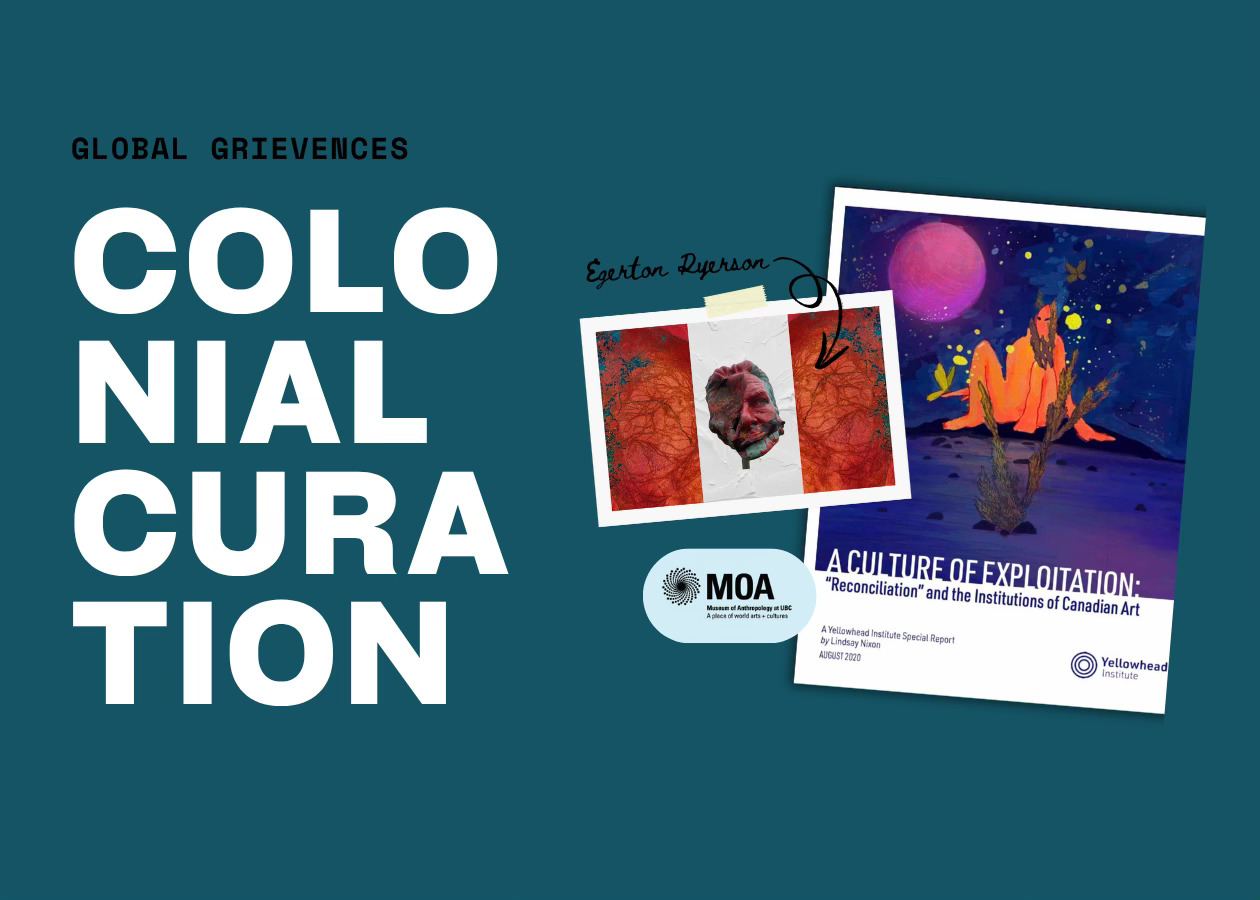
Kickstarting my journey of understanding reconciliation, The Yellowhead Institute is an Indigenous-led research and education centre. In 2020, the institute published a special report, A Culture of Exploitation: "Reconciliation" and the Institutions of Canadian Art. A special report that I find myself returning to five years later in hopes of recognizing National Indigenous Peoples Day through meaningful engagement with Indigenous Culture at The Museum of Anthropology (MOA) at the University of British Columbia.
Following intense seismic upgrades and a reframing of the museum’s curatorial practices, The MOA has been successful in meeting a number of the Yellowhead Institute’s calls to action for curatorial institutions. An example is the MOA’s continued work to digitize their collection and reduce barriers to access for Indigenous peoples through various means. Additionally, the Museum’s implementation of the United Nations Declaration on the Rights of Indigenous Peoples (UNDRIP) reinforces their commitment to work through the ambiguity of reconciliation and place Indigenous knowledge holders at the center of conversations– far ahead of the federal government.
Much like greenwashing has acted for environmental advocacy, reconciliation has been touted by institutions, organizations, and corporations as a means to establish virtue and progressive attitudes. Yet the ambiguity of the term often yields no progression in reconciling over 150 years of colonial harms. As the special report illuminates, reconciliation efforts often have consequences for Indigenous people, namely the tokenization of Indigenous employees whose individual attributes and skills are pushed aside and their indigeneity boasted for niche grants, publicity, and diversity efforts.
This gross exploitation in the name of reconciliation should really make us, as settlers or visitors on this land, stop and think twice about how and where we consume or engage with Indigenous Culture. I am hopeful the MOA has surpassed superficial claims of reconciliation and is genuinely invested in respectful and collaborative care of the materials in their care.
I will be, and I encourage you to do the same if you can, attending the MOA this month to experience first-hand the cultural materials of First Nations, Metis, and Inuit peoples of so-called Canada. I am hopeful the MOA is turning a new page for responsible curation of cultural materials in a colonial context. Start or continue your journey of reconciliation at the MOA, just make sure to ask who is telling the story.