Biometric Normalcy
Biopolitics & Bodies
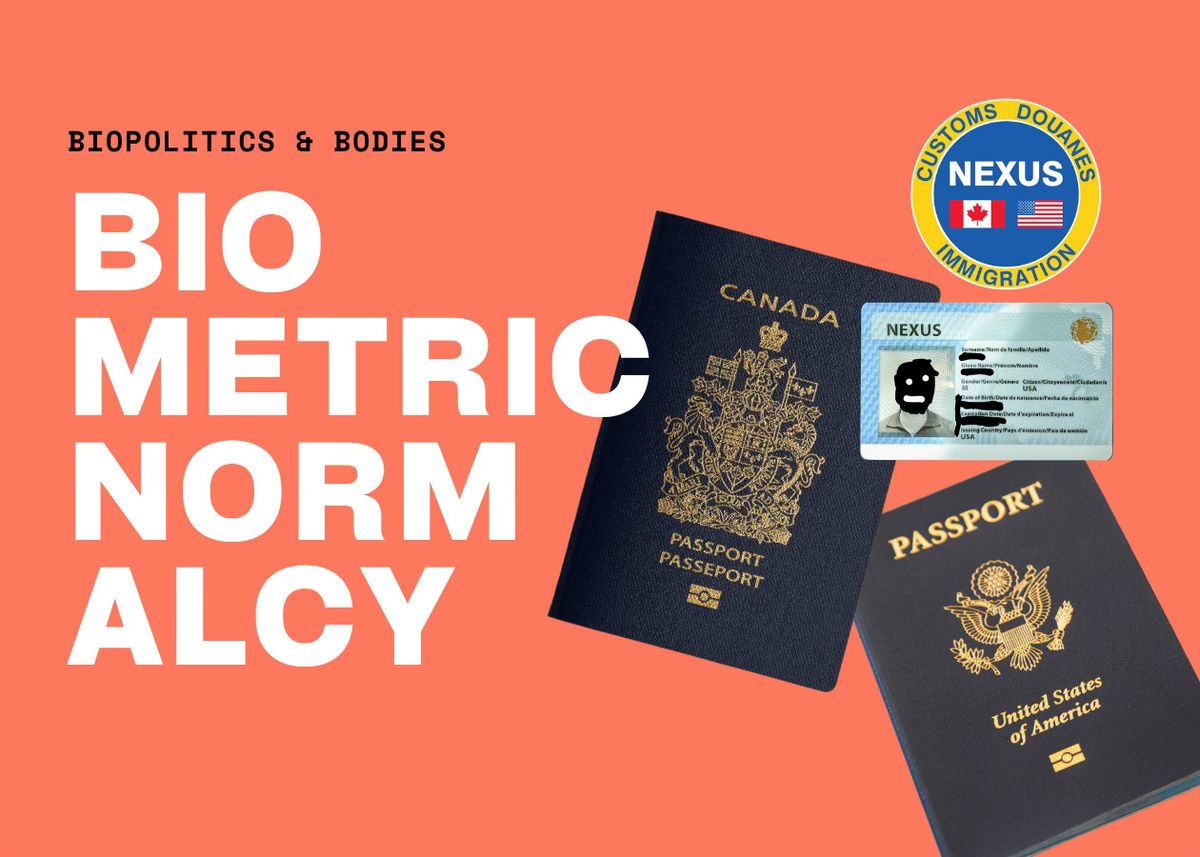
Nexus: The US and Canada’s Gateway to Biometric Normalcy
‘Low-risk’, ‘pre-screened’, and codified individuals have been sold convenience and status at the cost of increased surveillance by multiple agencies. Piloting pre-9/11 between Windsor and Detroit, NEXUS has grown into a highly developed ID System that is built on voluntary yet exclusive membership – where members offer their biometric data and consent to have their identity verified and ‘risk’ authorized by the US, Canada, and other globally integrated customs databases (The White House 2002). In exchange, participants gain expedited processing at specific land, sea, and air ports. This critical response seeks to stress how this voluntary and incentivized program has paved the way to normalized biometric collection and increased surveillance measures in Canada and the US. Arguing that NEXUS ID cards and associated ID systems have acted to ease citizens into global identification databases. Highlighting that specialized IDs act as bargaining tools for increasing biopower. Adding new levels of categorization; fingerprints, iris identification and trusted traveller status, which go beyond traditional national passports.
Summary
The NEXUS program started as a pilot program in 2000, offering increased speed for US and Canadian travellers at the largest land border crossing, signalling a strong national relationship between the two countries (The White House 2002). Following 9/11 the program paused operations and via the December 2001 Smart Boarder Declaration was reinstated with firmer goals. Beyond trade and travel relations the US and Canada vowed to make North America more secure and prosperous. The Smart Border Declaration had four goals: secure flow of goods, secure flow of people, secure infrastructure, and coordination and information-sharing in the enforcement of these objectives (The White House 2002: CNN 2001). Both NEXUS and traditional National passport ID systems have grown, yet through the voluntary nature of NEXUS ID membership, it has far succeeded the passport system in collecting biometric data. It is important to note the brief history of the Canadian passport to contrast the advancements of the NEXUS ID. Canadians seeking to travel to the US did not need a passport to do so until 2007 by air and 2009 by land or sea (CBC 2009). While introduced through the Northern Hemisphere Travel Initiative (WHTI) both roll-out dates faced several extensions due to both logistical and public pushback (CBC 2009). Later, Canada implemented the ePassport in 2010 which enables facial recognition, the extent of biometric features imbedded in Canadian passports to date (Government of Canada 2014). With more general security measures through innovative ink and artwork being added to all passports in 2023 (Government of Canada 2023).
In contrast, since 2001, NEXUS has employed Radio Frequency Identification Cards (RFID) to house iris and fingerprint data of approved travellers. This allows distanced scanning and retrieval of biometric and personal data, which allows for quicker identification of low-risk travellers (The White House 2002). This process allows travellers to avoid more intrusive and physical searches while crossing national borders, for example avoiding removing shoes or going through sophisticated X-ray machines in airports. To verify applicants’ identification, data is digitally shared and verified through various customs databases beyond Canada and the US, trading extensive amounts of personal identifiers for pre-clearance. Additionally, reviewed applications are subject to an interview with both the US and Canada’s customs agencies, a process that may need to be repeated upon five-year renewal increments. The physical ID cards and use by travellers have not seen many changes since its inception, yet membership has grown to 1.7 million US and Canadian citizens as of May 2021 (Thompson 2021).
Contrasting the increase in NEXUS membership, thousands of NEXUS ID card holders have had their trusted traveller status revoked (Thompson 2021). Of these thousands of revocations, many individuals were unclear of the reasoning for dismissal and processes of appeal and highlighted the contrast between the US and Canada’s practices (Thompson 2021). Citing the US to be the main perpetrator of revocation and for having a strong zero-tolerance policy for any ambiguous behaviour (Thompson 2021).
Analysis
As a single piece of ID, NEXUS cards and their unique ID systems exemplify various theoretical concepts that are involved in analysing surveillance. Of most interest is the concept of biopower as described by Foucault (1978) as the subjugation of bodies and the control of populations. This response argues NEXUS ID systems are an instrument of biopower.
As articulated by Lyon (2009), ID cards are a surveillance practice that categorizes individuals, describing such as social sorting. Such sorting, by ‘othering’ individuals can enable discrimination between groups. Lyon (2009) looks at this concept through national ID Cards, while NEXUS ID cards expand the scope. As an optional transnational or multipurpose ID Card, NEXUS inserts individuals into both searchable and global databases. A process Lyon (2009) discusses as ‘interoperation’ between groups or agencies. NEXUS ID showcases the internal and external effects of social sorting due to its voluntary and ‘exclusive’ nature. Exemplifying the created categorization by organizations, as well as the individuals’ perceived status, in which both foster the ‘othering’ that furthers biopower.
Social-sorting acts to promote biopower or biopolitics. Where subjugation of bodies and control of populations is eased through the categorization of people or groups (Foucault 1978. Through the language of security during a time of fear post 9/11, the NEXUS card was able to justify and sell convenience and safety for the high cost of biometric data that is now being shared through global databases. NEXUS ID has continued to grow memberships since through continued transborder relationships. Now with 1.7 million members, the NEXUS ID system has a robust amount of biometric, personal, and movement data to share and analyze with other agencies. Fueling the fire of biopower in doing so. With more data and more ability to categorize people agencies have more power to discriminate and control populations. One example of the various ways this data could be used to control or harm individuals is the reports of thousands of random revocations of NEXUS ID cards. Along with claims of no clear judicial process in appealing revocations or learning the reason as to why. Begging the question as to how these individuals’ identities are being classified. This pulls in the idea of exclusion via inclusion, where individuals may now have precariously categorized identities as a consequence of providing extensive personal data and consenting to the unwritten rules of transnational surveillance.
Now with over 20 years of practice and 1.7 million members, there is a strong foundation for developing a larger compulsory biometric collection with national passports. At NEXUS’s inception, there was not enough evidence or knowledge of such data that blanket biometric collection of fingerprints or iris scanning would not have been feasible, but NEXUS ID got the ball rolling. Through voluntary means, the US and Canada were able to develop how to carry out such tasks and frame reasons for doing so. This now puts both nations in better positions to approach further biometric collection, which would afford them better surveillance of their populations.
Conclusion
The NEXUS ID system evoked a new dimension of the monopolization of legitimate movement. Starting in 2000 this ID system with the help of new technologies kicked off the collection of biometric data for US and Canadian citizens. In doing so a large foundation has been made for the collection and sharing of biometric data between nations that without NEXUS would not exist. The trade-off between data sharing and ‘trusted-traveller’ status helped the US and Canada promote technologies that fuel biopower. Surveillance measures that otherwise would not have been able to be tested and used as they were unfamiliar and unwarranted to Americans and Canadians at the time. Perhaps the foundation that NEXUS has made will be enough to convince whole nations to hand over their fingerprints, iris scans and more. Overall, a greater focus needs to be placed on how specialty ID Cards play a unique role in the status and categorization of individuals in otherwise free nations.
You made it to the end and I have more to say, so make sure you don’t miss it.
And because I have them,
References
CBC (May 12, 2009). Timeline: Travel documents at the Canada-U.S. Border.
https://www.cbc.ca/news/canada/timeline-travel-documents-at-the-canada-u-s-border-1.834929
CNN (December 13, 2001). U.S., Canada Sign ‘Smart Border’ declaration. [War Against Terror Coverage].
https://edition.cnn.com/2001/US/12/12/rec.canada.border/
Foucault, Michel. 1978 [1976]. The History of Sexuality Volume One: An Introduction. New York: Vintage Books. Part 5 Right of Death and Power over Life, 133-159.
Government of Canada (May 13, 2014). History of the ePassport.
https://www.canada.ca/en/news/archive/2014/05/history-epassport.html#
Government of Canada (June 29, 2023). Features of Canada’s New Passport.
https://www.canada.ca/en/immigration-refugees-citizenship/services/canadian-passports/new-passport-features.html
Lyon, David. 2009. Identifying Citizens: ID Cards as Surveillance. Cambridge, UK: Polity. Chapter 1 Demanding Documents.
Thompson, E. (July 7, 2021). U.S. officials have revoked thousands of Canadian NEXUS Cards.
https://www.cbc.ca/news/politics/canadausbordernexus1.6092307#:~:text=The%20CBSA%20said%20there%20were,the%20category%20of%20%22other%22.
The White House (December 6, 2002). U.S. – Canada Smart Border/30 Point Action Plan Update [Press Release].
https://georgewbushwhitehouse.archives.gov/news/releases/2002/12/20021206-1.html
The White House (September 9, 2002). Remarks by the President and Prime Minister Chretien on the U.S. – Canadian Smart Borders [Press Release].
https://georgewbush-whitehouse.archives.gov/news/releases/2002/09/20020909-4.html